Mice have a strong preference to nest away from their own waste and should be housed in a system of cages that allows them to create a toilet area, according to work led by researchers at the University of British Columbia.
The study, published April 16 in Scientific Reports, showed that mice who were housed in a system of three interconnected cages used separate cages for nesting and eliminating waste.

Joanna Makowska
The findings suggest that mice—used in more biomedical research than any other animal—should be provided with a so-called “en suite bathroom” space to ensure their welfare. Standard housing for these laboratory animals consists of simple cages with a single, small, open space.
“This finding is important, because housing mice in constant contact with their excrement is common practice in laboratories,” said Joanna Makowska, adjunct professor in the UBC faculty of land and food systems’ animal welfare program. “Housing animals in an environment they are motivated to avoid compromises their welfare, and may also negatively affect research data.”
Scientists believe that the segregation of space into clean and dirty areas is a behaviour that has evolved among many species as protection against disease. The UBC researchers were the first to directly test whether mice do it as well. They began by housing 60 mice, divided into small groups between standard single-compartment cages, and complex “triad” caging systems that featured three separate compartments connected by external tunnels.
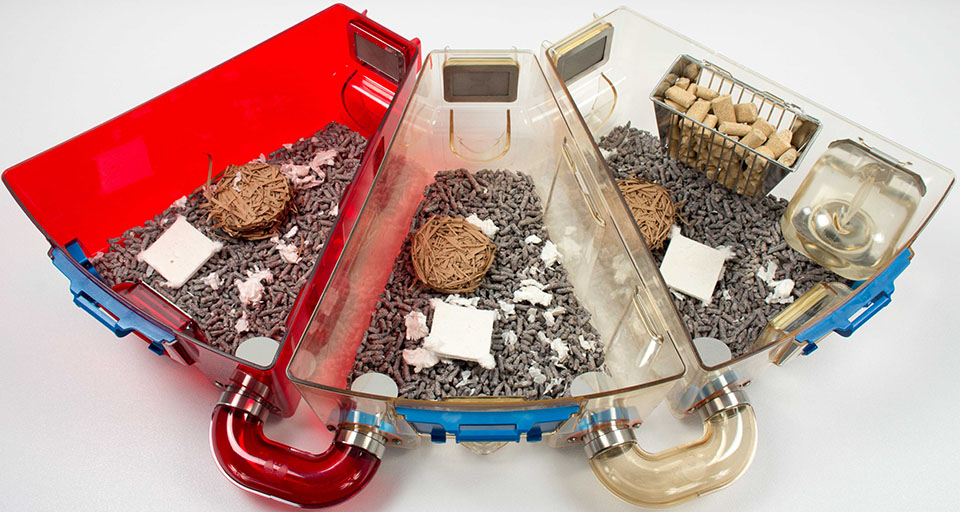
‘Triad’ housing consists of three compartments set up with tunnels connecting them on the outside.
During 15 weeks of observation, mice nested and urinated in the same location only two per cent of the time. Even the mice in single compartments made an effort to keep their nesting and waste areas separate within their cage, while the mice in triads used separate compartments for each.
The researchers also discovered that mice moved bedding and nesting material between the cages, showing that they were willing to work to maintain a comfortable place to rest, well away from the dirty compartment.
“In humans, the most common elicitors of disgust are feces and urine. This finding opens avenues for exciting new research, such as whether disgust is a reaction that has evolved across species in much the same way that pleasure and pain have,” said Makowska.
“Our ultimate goal, however, was to give mice more autonomy in designing their own space and thereby enhance our appreciation for their capabilities and preferences,” said co-author Becca Franks, a former postdoctoral fellow in the animal welfare program who is now visiting assistant professor at New York University.
https://news.ubc.ca/2019/04/23/good-mousekeeping-en-suite-bathroom-makes-for-ha…